
Crypto markets move fast—and if you’re here, you’re likely looking for clear, reliable insights that cut through the noise. Whether you want to understand emerging crypto trends, decode blockchain mechanics, evaluate digital asset investment strategies, or explore token utility models, this article is built to give you exactly that.
Investors and enthusiasts often struggle to separate hype from substance. Protocol updates, shifting narratives, and new tokens launch daily, making it difficult to build and maintain a diversified crypto portfolio with confidence. This guide breaks down the mechanics behind the headlines, highlights practical wallet setup considerations, and explains how different crypto assets generate and sustain value.
Our analysis is grounded in continuous market monitoring, technical evaluation of blockchain protocols, and real-world observation of digital asset performance cycles. By the end, you’ll have a clearer framework for assessing opportunities, managing risk, and making informed decisions in an increasingly complex crypto landscape.
Back in 2017, when Bitcoin first rocketed into mainstream headlines, most portfolios were little more than single-coin bets. Fast-forward to today, and the market spans thousands of tokens, from Layer 1 protocols to DeFi and NFTs. The challenge isn’t access; it’s survival through brutal cycles. After studying multiple boom-and-bust phases, we advocate building a diversified crypto portfolio across infrastructure, utility, and speculative plays. Critics argue concentration maximizes upside, and sometimes it does. However, sustainable growth favors allocation discipline, periodic rebalancing, and clear risk limits (think less lottery ticket, more marathon). Over time, structure turns chaos into strategy. Stay patient.
The Foundation: Why Portfolio Diversification is Non-Negotiable in Crypto
Back in 2021, many investors learned the hard way that Bitcoin and Ethereum often move together. This tendency is called correlation—a measure of how assets move in relation to one another. When correlation is high, prices rise and fall in tandem. True balance means owning assets that don’t all react the same way at the same time.
Some argue diversification caps profits. Why not go all-in on the “next 100x coin”? Because survival beats short-lived glory. A diversified crypto portfolio isn’t about limiting upside; it’s about mitigating drawdowns so you can compound over years, not weeks (remember how fast sentiment flipped in 2022?).
It also lets you capture sector-specific growth without overexposure:
- DePIN infrastructure plays
- AI-focused protocols
- Blockchain gaming ecosystems
The real goal? Stop chasing moonshots and start building something durable enough to weather any cycle.
Constructing Your Core: The Bedrock of Your Crypto Investments
Before chasing the next 10x token, you need a core. In crypto investing, your “core” refers to established, highly liquid, and dominant assets that make up roughly 50–70% of your holdings. Think of it as the foundation of a house—no one brags about it, but without it, everything collapses.
Asset #1 – Bitcoin: The Digital Gold
Bitcoin is often called a store of value, meaning it’s designed to preserve purchasing power over time. With a fixed supply of 21 million coins, it’s frequently compared to gold as an inflation hedge (Fidelity Digital Assets, 2022). Its network security—maintained by global miners using proof-of-work—and deep decentralization form the backbone of its investment thesis.
Practical tip: If you’re starting out, consider allocating 30–50% of your portfolio to Bitcoin. Use dollar-cost averaging (buying fixed amounts at regular intervals) to reduce volatility risk.
Asset #2 – Ethereum: The Global Computer
Ethereum is a smart contract platform—software that runs exactly as programmed without intermediaries. It powers DeFi (decentralized finance), NFTs, and thousands of decentralized apps. After the 2022 Merge to proof-of-stake, Ethereum introduced deflationary mechanics through fee burning (Ultrasound Money data), reducing supply over time.
Action step: Allocate 20–40% to ETH to gain exposure to blockchain utility and innovation.
Allocation Strategy
A sample core split might look like:
- 40% Bitcoin
- 30% Ethereum
This 70% foundation stabilizes a diversified crypto portfolio while leaving room for higher-risk opportunities. Some argue smaller caps offer faster growth—and they can—but building on a weak core is like building on sand (and we’ve seen how that movie ends).
Adding Satellites: Fueling Growth with Calculated Risk
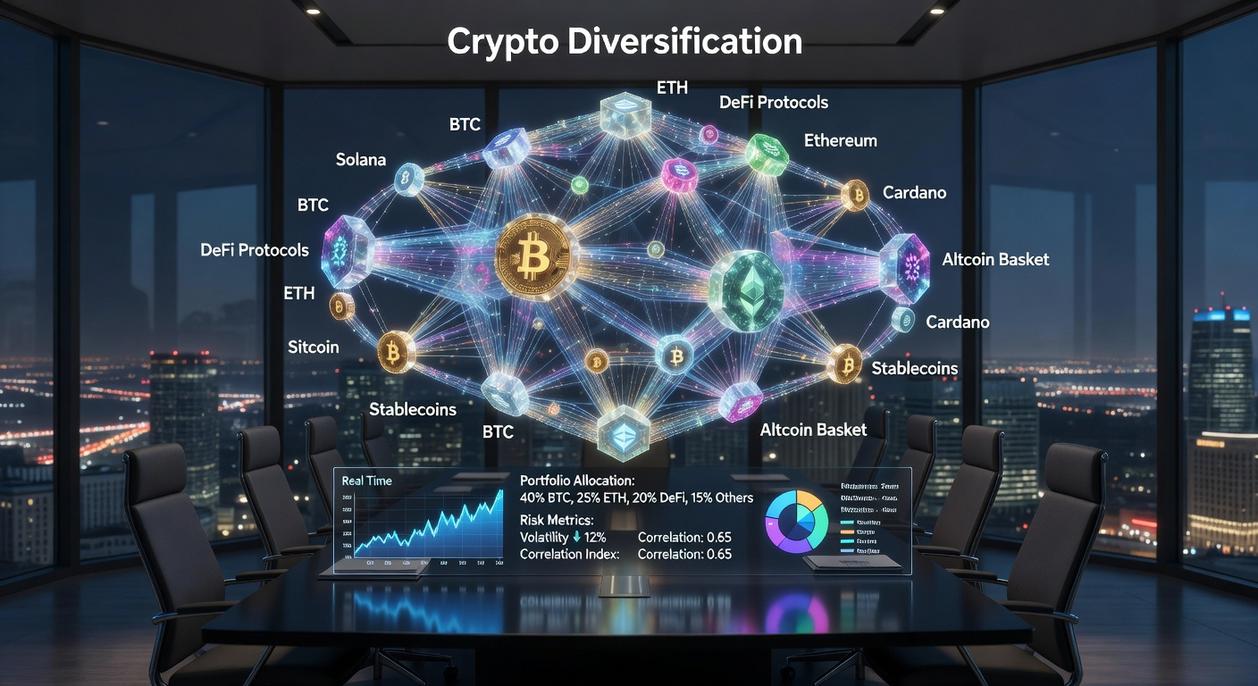
I’ll start with a quick story. In 2021, I added a small Layer-1 token to my portfolio after testing its network speed myself. Transactions settled in seconds, fees were negligible, and developer activity was climbing. It felt speculative—because it was. But that “satellite” position ended up outperforming my core holdings for months. The lesson? CALCULATED RISK beats random hype.
A satellite allocation refers to higher-risk, higher-reward assets that complement your core positions—typically 20–40% of a diversified crypto portfolio. Think of them as growth engines orbiting your more stable assets.
Category 1 – Layer-1 Challengers
Layer-1 blockchains are base networks that process and finalize transactions. Ethereum competitors often promise faster throughput (transactions per second) and lower gas fees. Look for:
- Active developer ecosystems
- Rising total value locked (TVL)
Skeptics argue most challengers will fade. That’s fair—many will. But just as Android challenged iOS dominance, competition drives innovation (and opportunity).
Category 2 – DeFi Blue Chips
Decentralized Finance (DeFi) protocols enable lending, borrowing, and trading without intermediaries. Blue chips here are battle-tested platforms with strong liquidity and audits. Critics say smart contract risk remains high—and they’re right. That’s why position sizing matters.
Category 3 – Niche Sector Plays
Blockchain gaming, DePIN (decentralized physical infrastructure networks), and AI-linked tokens are speculative edges. Small bets only. Volatility is the price of admission.
Risk Management for Satellites
Satellites demand discipline. Smaller allocations. Clear exit rules. Emotional control.
If you need structure, study proven risk management techniques for volatile crypto markets.
Because satellites can soar—but they can also BURN. The key is knowing the difference before you invest.
The Stability Layer: Using Stablecoins for Defense and Yield
Beyond speculation, stablecoins are cryptocurrencies pegged to stable assets like the U.S. dollar, designed to reduce volatility. In a diversified crypto portfolio, allocating 5–10% to them functions as a strategic cash position.
During market downturns, prices of major tokens can swing wildly; by contrast, stablecoins aim to hold steady. That stability preserves capital and, importantly, lets you buy quality assets at discounted prices when fear peaks (think “buy the dip”).
Moreover, stablecoins can generate passive income. By depositing them into lending protocols or liquidity pools—platforms that facilitate borrowing and trading—you may earn relatively predictable yield. While not risk-free, these returns are typically lower risk than speculative tokens.
However, security matters. Use reputable wallets—software or hardware tools that store private keys—and established platforms. Pro tip: enable two-factor authentication and verify smart contract audits before committing funds. Caution reduces surprises in volatile markets over time.
What to Do After You Build the Blueprint
Now that you have a framework, the obvious question is: what’s next? First, audit your current holdings. Do they actually reflect a Core-Satellite structure, or are they a collection of impulse buys (we’ve all had at least one)? Next, rebalance with intention—anchor your core in established assets, then allocate a controlled percentage to higher-risk plays to form a truly diversified crypto portfolio.
Some argue strict models limit upside. Fair point. But without structure, volatility often dictates decisions instead of strategy. Finally, set a quarterly review schedule. Markets evolve, and your portfolio should too—deliberately, not reactively.
Stay Ahead in Crypto With the Right Strategy
You came here to better understand crypto trendwatch, blockchain mechanics, token utility models, and how to position yourself in a fast-moving digital asset market. Now you have a clearer view of how these pieces connect—and how they can work together to strengthen your investment approach.
The reality is that crypto moves fast. Missed trends, poorly structured wallets, or unclear token utility can quickly turn opportunity into regret. Without a clear strategy, volatility becomes a threat instead of an advantage.
Building a diversified crypto portfolio grounded in real utility, strong protocols, and informed market analysis is how you reduce risk while staying positioned for upside. When you combine smart wallet setup, a deep understanding of blockchain fundamentals, and disciplined allocation strategies, you shift from reacting to the market to leading your own results.
Now it’s time to take action. Start refining your portfolio strategy today, review your wallet security, and align your holdings with real-world token utility and emerging trends. Join thousands of investors who rely on trusted, data-driven crypto insights to stay ahead—don’t let uncertainty cost you your next opportunity. Take control now and turn clarity into confident growth.
 Stephenic Uhligsodans has opinions about digital asset investment strategies. Informed ones, backed by real experience — but opinions nonetheless, and they doesn't try to disguise them as neutral observation. They thinks a lot of what gets written about Digital Asset Investment Strategies, Blockchain Mechanics and Protocols, Expert Insights is either too cautious to be useful or too confident to be credible, and they's work tends to sit deliberately in the space between those two failure modes.
Reading Stephenic's pieces, you get the sense of someone who has thought about this stuff seriously and arrived at actual conclusions — not just collected a range of perspectives and declined to pick one. That can be uncomfortable when they lands on something you disagree with. It's also why the writing is worth engaging with. Stephenic isn't interested in telling people what they want to hear. They is interested in telling them what they actually thinks, with enough reasoning behind it that you can push back if you want to. That kind of intellectual honesty is rarer than it should be.
What Stephenic is best at is the moment when a familiar topic reveals something unexpected — when the conventional wisdom turns out to be slightly off, or when a small shift in framing changes everything. They finds those moments consistently, which is why they's work tends to generate real discussion rather than just passive agreement.
Stephenic Uhligsodans has opinions about digital asset investment strategies. Informed ones, backed by real experience — but opinions nonetheless, and they doesn't try to disguise them as neutral observation. They thinks a lot of what gets written about Digital Asset Investment Strategies, Blockchain Mechanics and Protocols, Expert Insights is either too cautious to be useful or too confident to be credible, and they's work tends to sit deliberately in the space between those two failure modes.
Reading Stephenic's pieces, you get the sense of someone who has thought about this stuff seriously and arrived at actual conclusions — not just collected a range of perspectives and declined to pick one. That can be uncomfortable when they lands on something you disagree with. It's also why the writing is worth engaging with. Stephenic isn't interested in telling people what they want to hear. They is interested in telling them what they actually thinks, with enough reasoning behind it that you can push back if you want to. That kind of intellectual honesty is rarer than it should be.
What Stephenic is best at is the moment when a familiar topic reveals something unexpected — when the conventional wisdom turns out to be slightly off, or when a small shift in framing changes everything. They finds those moments consistently, which is why they's work tends to generate real discussion rather than just passive agreement.